DNS Reconnaissance
Queried Active Directory DNS records and SRV records to identify domain controllers, Kerberos, LDAP and Global Catalog services.
Cybersecurity / Homelab
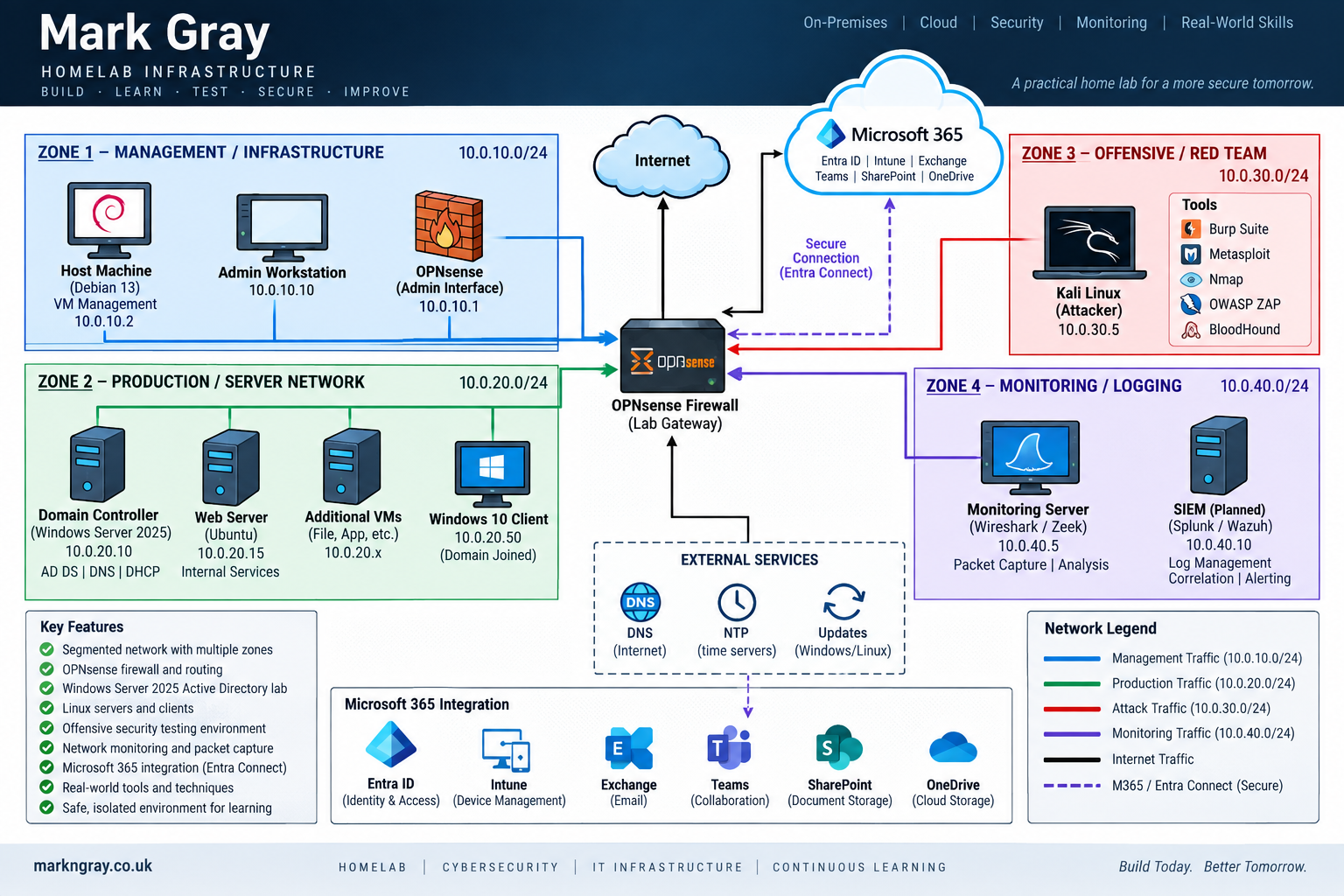
A segmented attacker-and-target environment used to practise authorised Active Directory reconnaissance, enumeration and defensive investigation.
Project Overview
The objective is to understand how an Active Directory environment appears from an attacker perspective, which services expose useful information, and how that activity can be recognised and investigated defensively.
Environment
The lab separates the Kali attacker system from the Windows Server production network using OPNsense. The domain controller provides DNS, Kerberos, LDAP, SMB and Global Catalog services. Evidence is saved and reviewed as part of each testing phase.
What I Did
Queried Active Directory DNS records and SRV records to identify domain controllers, Kerberos, LDAP and Global Catalog services.
Tested anonymous SMB access, protocol support and SMB signing requirements while documenting what was and was not exposed.
Queried LDAP RootDSE information and validated Kerberos services before moving into controlled username enumeration.
Stored command output and findings in a structured project repository rather than relying on transient terminal output.
Troubleshooting
Initial DNS and firewall rule ordering prevented expected lab traffic, requiring troubleshooting at the network layer.
Several enumeration paths were correctly restricted, which helped distinguish between an exposed service and an exploitable configuration.
Learning
Built a stronger understanding of the relationship between DNS, SMB, LDAP and Kerberos in a Windows domain.
Learned to build findings progressively instead of jumping directly to exploitation.
Each offensive test is considered alongside the logs and network evidence a defender could use to detect it.
Evidence & Findings
A targeted Nmap scan confirmed the core services expected on the domain controller.
53/tcp   open  domain
88/tcp   open  kerberos-sec
389/tcp  open  ldap
445/tcp  open  microsoft-ds
3268/tcp open  globalcatLDAP
SMB enumeration showed modern protocol support and that SMB signing was required.
445/tcp open microsoft-ds

SMB2 security mode:
  Message signing enabled and required
Anonymous RootDSE queries returned directory metadata without exposing broader directory contents.
defaultNamingContext: DC=soundmagus,DC=local
rootDomainNamingContext: DC=soundmagus,DC=local
dnsHostName: WIN-N27EB14TU2H.soundmagus.local
supportedLDAPVersion: 3
supportedLDAPVersion: 2
A controlled Kerbrute user-enumeration test validated one username from a five-entry test list.
VALID USERNAME:
administrator@soundmagus.local

5 usernames tested
1 valid username identified
The Kali attacker system could reach the network but DNS queries through the lab gateway were failing.
Checked OPNsense interface rules, DNS service bindings, rule ordering and direct UDP/53 reachability.
Correcting the firewall rule order allowed DNS queries through OPNsense and restored normal name resolution.
Next Steps
Continue LDAP/Kerberos enumeration, add more defensive monitoring and eventually correlate offensive activity with SIEM alerts and Windows security events.